CoatFusion:
Controllable Material Coating in Images
Sagie Levy, Elad Aharoni, Matan Levy, Ariel Shamir, Dani Lischinski
Hebrew University of Jerusalem

Overview. Our method, CoatFusion, coats objects in input images with materials defined by albedo images, masks and parametric controls. Left: Examples of objects coated with different materials: matte finish, metallic spray, and reflective paint. Right: Individual parameter controls demonstrated across different objects: thickness control (thin to thick coating), roughness control (glossy to matte finish), and color control (arbitrary RGB color selection).
Abstract
We introduce Material Coating, a novel image editing task that simulates applying a thin material layer onto an object while preserving its underlying coarse and fine geometry. Material coating is fundamentally different from existing “material transfer” methods, which are designed to replace an object’s intrinsic material, often overwriting fine details. To address this new task, we construct a large-scale synthetic dataset (100K images) of 3D objects with varied, physically-based coatings, named DataCoat110K. We then propose CoatFusion, a novel architecture that enables this task by conditioning a diffusion model on both a 2D albedo texture and granular, PBR-style parametric controls, including roughness, metalness, transmission, and a key thickness parameter. Experiments and user studies show CoatFusion produces realistic, controllable coatings and significantly outperforms existing material editing and transfer methods on this new task.
Method
We implement an architecture which accepts global control parameters for material properties, as well as a 2D mask and a 2D albedo map based on pre-trained FluxFill rectified flow model. These embeddings allow for precise, parametric adjustments of properties like roughness, metalness, and a thickness parameter. This paremeter modulates coating opacity and surface smoothing, simulating the coating behavior for varying levels of thickness. The model was trained on DataCoat110K, our large-scale synthetic dataset of 110,000 physically-based coating pairs generated in Blender

Comparisons
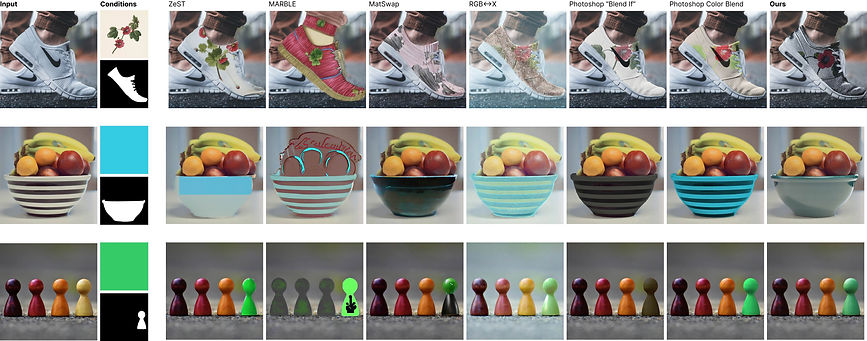
We evaluated CoatFusion against current state-of-the-art material transfer methods, including ZeST, MARBLE, MatSwap and RGB↔X, as well as classical heuristic baselines like Photoshop’s "Blend If". As shown in the comparison figure below, while existing learning-based methods often overwrite the substrate’s intrinsic details, CoatFusion successfully preserves the original geometry and fine-scale texture while applying a new material layer. Quantitatively, our method consistently outperforms all baselines across every metric, including geometric consistency (Depth and Normals) and shading fidelity, achieving an improvement in PSNR. Furthermore, our user study confirms these results, with participants choosing CoatFusion as the more realistic and natural material application in 76.9% of all tasks.
More Results

BibTeX
@article{levy2025coatfusion,
title={CoatFusion: Controllable Material Coating in Images},
author={Levy, Sagie and Aharoni, Elad and Levy, Matan and Shamir, Ariel and Lischinski, Dani},
journal={arXiv preprint arXiv:2512.02143},
year={2025},
url={https://arxiv.org/abs/2512.02143}
}